When English Has No Word for It — And That Tells You Everything
Here's something that happens a lot in Japanese language classes across the US: a student encounters a word they can't translate, spends ten minutes trying anyway, and then just... stops. Not because they gave up. Because somewhere in the middle of that struggle, something clicked.
That word was doing something English never needed to do.
Japanese has a whole category of vocabulary that doesn't map cleanly onto English equivalents — and language teachers will tell you that these untranslatable words are often the most valuable ones to learn, even if you never use them perfectly. They're not just linguistic curiosities. They're little windows into a completely different way of organizing human experience.
The Word That's Just a Pause — But Also So Much More
Take ma (間). On the surface, it translates loosely as "gap," "pause," or "negative space." But those translations miss the point almost entirely.
Ma is the meaningful silence between notes in music. It's the breath before someone responds in a conversation. It's the empty space in a room that makes the room feel balanced. In Japanese aesthetics, ma isn't an absence — it's a presence. It's the thing that gives everything around it shape.
Sarah Lindqvist, who teaches Japanese at a community college in Portland, Oregon, says ma is usually the word that stops her students cold.
"They'll ask me to translate it, and I'll try, and I can see on their faces that I haven't really answered the question," she says. "And then I tell them — that feeling you're having right now, that slight frustration of not quite grasping it? That's actually kind of what ma is. It lives in the space between knowing and not knowing."
For Americans especially, ma can feel almost confrontational. US culture tends to treat silence as a problem to solve — a gap in conversation that needs filling, dead air that signals awkwardness or discomfort. Ma suggests the opposite: that the pause is where meaning lives.
Nostalgia That Doesn't Quite Hurt
Then there's natsukashii (懐かしい), which gets loosely translated as "nostalgic" — but that's only about halfway there.
English nostalgia carries a melancholy edge. It's bittersweet, sometimes even painful. You miss something and you know you can't have it back. Natsukashii is warmer than that. It's the feeling of suddenly remembering something good — a smell, a song, a random Tuesday from fifteen years ago — and feeling genuinely happy that it happened, even though it's gone.
Kenji Watanabe, a Japanese-American writer based in Chicago who grew up speaking both languages at home, describes it this way: "Nostalgia in English sounds like grief with a soft edge. Natsukashii sounds like gratitude. It's the feeling of 'oh, I'm so glad that existed.' There's no mourning in it."
When American learners discover natsukashii, many say it fills a gap they didn't know was there. "I'd been using 'nostalgic' my whole life and never quite felt like it fit," one learner wrote in an online Japanese study group. "Natsukashii is the word I actually needed."
Light Through Leaves — And the Whole Philosophy Behind It
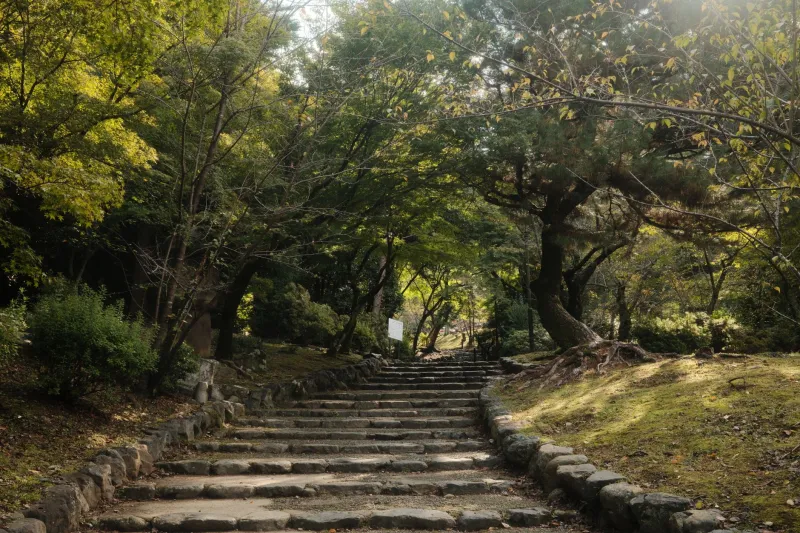
Komorebi (木漏れ日) is probably the most visually specific untranslatable Japanese word that gets passed around in English-speaking spaces. It refers to sunlight filtering through the leaves of trees — that dappled, moving light you see on a forest floor or a sidewalk on a windy afternoon.
English doesn't have a single word for this. We describe it in phrases, if we bother describing it at all.
But the existence of komorebi says something about Japanese culture's relationship with nature — specifically, the idea that small, transient natural moments are worth naming. Worth noticing. The Japanese aesthetic concept of mono no aware (物の哀れ), sometimes translated as "the pathos of things," reflects a cultural attentiveness to impermanence and beauty that shows up again and again in the language.
For many American learners, komorebi becomes a kind of gateway word. Once you know it exists, you start noticing the thing it describes. And once you start noticing it, you start wondering what else you've been walking past without seeing.
"Learning komorebi changed how I take walks," says Marcus Delray, a graphic designer in Austin who started studying Japanese during the pandemic. "That sounds ridiculous, but it's true. Now I actually stop and look at that light. The word gave me permission to care about it."
What These Words Are Really Saying About Communication
This is where it gets interesting for anyone thinking about cross-cultural communication — which is kind of the whole point of what we do here at そうだん.net.
These words aren't just poetic. They reveal structural differences in how Japanese and American cultures approach emotion, attention, and connection.
Japanese communication often operates on indirection and implication — what's left unsaid can carry as much weight as what's spoken. Ma reflects that. American communication tends toward explicitness and directness — say what you mean, fill the silence, make your point clear. The fact that English doesn't have a word for ma isn't a coincidence. It reflects a cultural assumption that silence is empty.
Similarly, the warmth of natsukashii versus the melancholy of nostalgia hints at different cultural relationships with the past. And komorebi's specificity suggests a culture that built attentiveness to small moments directly into its language.
None of this means one approach is better. But learning these words — really sitting with them — can be a surprisingly effective way to understand why Japanese and American people sometimes talk past each other, even when both parties are trying their best.
You Don't Have to Be Fluent to Benefit
Here's the thing language teachers keep coming back to: you don't need to speak Japanese to get something out of these words. The value isn't in using them correctly in a sentence. It's in letting them ask you a question.
What would your life look like if you had a word for the comfortable silence between close friends? What would you notice differently if your language had a name for dappled forest light? What would change about the way you remembered your past if the emotion had warmth in it instead of ache?
That's the conversation these words open up. And honestly, it's one worth having — even if you stumble over the pronunciation.
So the next time you're sitting with someone and the conversation goes quiet, maybe don't rush to fill it. Maybe that's your ma. Maybe it's doing exactly what it's supposed to do.